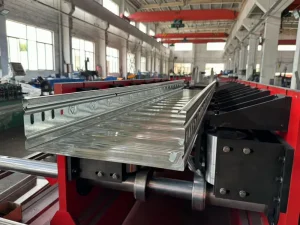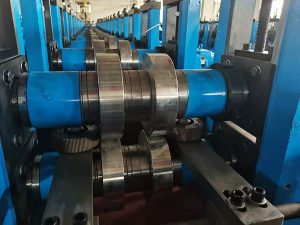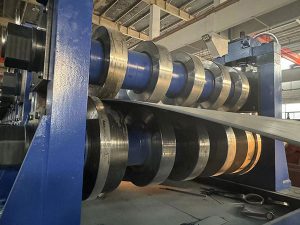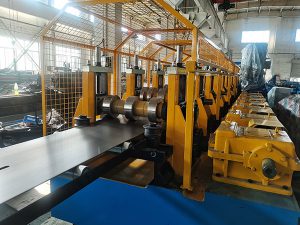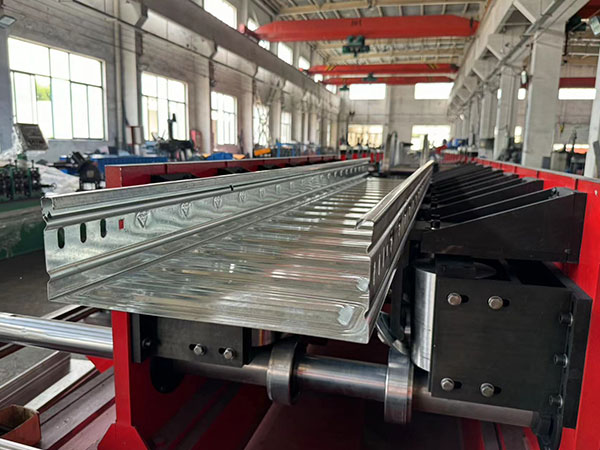
Cable tray has historically been made one piece at a time on bending machines. A roll forming line changes the economics: continuous forming, consistent bends, and one operator instead of a bending crew. Cable tray runs through electric power, communications, industrial, commercial and civil construction — it is a high-repetition product, which is exactly what roll forming is built for.
1. Width and height range
One line covers cable tray from 100–600 mm wide and 50–120 mm high, with the side hole pattern punched to your drawing. The width range is the first question to answer: it decides the frame width of the line and how many die sets you will run.
2. Speed — and the capacity math
Nominal forming speed is 0–15 m/min. Wide trays form slower than narrow channel, so plan your monthly output from the speed on your heaviest width, not from the maximum. The line is fully automatic: you set the production quantity and tray length on the control and it runs on its own.
3. Line configuration
The standard flow: 5-ton decoiler, servo feeder, punch press (punching and cutting), main roll forming machine (20 stations), outer table. Galvanized, PPGI and carbon steel coil, Cr12Mov rollers, casting frame, gearbox drive, Delta PLC with Yaskawa inverter.
| Forming stations | 20 |
|---|---|
| Forming speed | 0–15 m/min |
| Tray width | 100–600 mm |
| Tray height | 50–120 mm |
| Material | GI / PPGI / carbon steel coil |
| Punching | Press punch, hole pattern to drawing |
FAQ
- Q: What sizes can one machine produce? A: Cable tray 100–600 mm wide, 50–120 mm high, hole pattern to drawing.
- Q: What is the delivery time? A: 80 days after contract confirmation.
- Q: What is the line speed? A: 0–15 m/min, depending on the punching requirement.
Send us your tray sizes and monthly output, and we will reply with a configuration and quotation. View our cable tray roll forming machine.