Solar racking does not only run on channel — it runs on pipe too. High frequency (HF) welded pipe, also called ERW tube, is used across solar mounting, offshore photovoltaics, prefabricated buildings and animal husbandry structures. A tube mill is a bigger purchase than a channel line, so here is what to check before you order.
1. What HF welding gives you
High-frequency alternating current heats the edges of the steel strip and squeezes them into a strong, continuous longitudinal weld. The result is pipe with no seams to inspect one by one, at speeds a press-and-weld line cannot match: 0–80 m/min on our standard configuration (up to 100 m/min for lighter specs).
2. The line flow — and the part most buyers miss
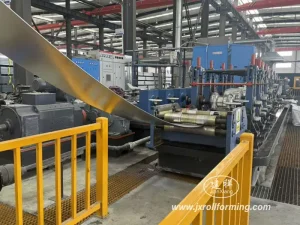
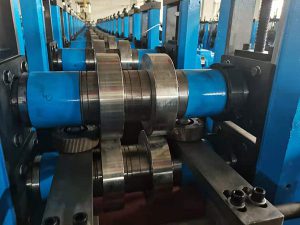
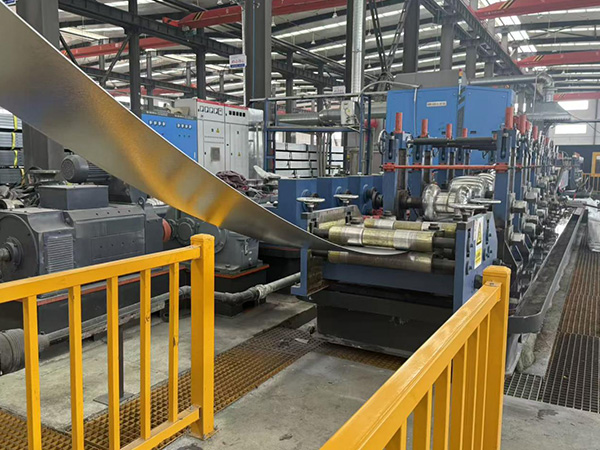
The full flow: 12-ton hydraulic decoiler with coil car and coil head shovel, press and leveler (2+5), coil head shear and welding, a horizontal loop accumulator, 7 forming stations, 6 sizing stations, the HF welder, external burr removal, cooling, straightening, fixed-length cold saw cutting, outer table and auto stacker.
The loop accumulator is the part to understand: it buffers coil so the welder never stops while you change coils or handle defects upstream. Continuous welding is the difference between a pipe plant and a demo line — ask exactly how the accumulator is sized.
3. Spec the pipe, not the machine
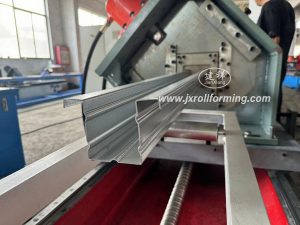
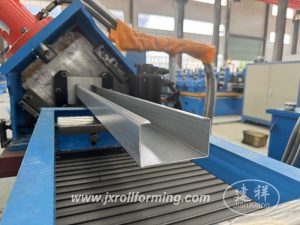
Start from the pipe range your racking market actually buys — the forming and sizing stations are built around that range. Our line runs galvanized, PPGI and carbon steel strip with 200 kW × 2 main motors, Siemens PLC and Yaskawa inverters on a casting frame with Cr12Mov rollers.
4. Space and power — budget for both
A tube mill is a building-scale project: plan about 100 m × 200 m of factory area, and check your power intake before you sign — the drive package alone is 2 × 200 kW.
What drives the price of an HF welding pipe mill
A pipe mill is priced by the tube schedule it has to run. Four variables dominate:
- Tube size range — a wider diameter span needs a larger roll set and more sizing stands, which is the biggest single item in the quotation.
- Wall thickness — 5.0 mm strip loads the forming stands and the 2 × 200 kW drive far more than 2.0 mm.
- Line speed — 80 m/min requires the heavier drive and the coil handling that goes with it, including a hydraulic decoiler.
- Cut-off and finishing scope — square cut only, or cut plus deburr and end-face in line. The finishing end is often underestimated at budget stage.
Send the tube schedule — outer diameter, wall thickness, section shape and annual tonnage. The roll set, sizing section and drive are specified around it, and the quotation is built line section by line section.
FAQ
- Q: What is the line speed? A: 0–80 m/min nominal, up to 100 m/min for lighter pipe specs.
- Q: What is the delivery time? A: 60 days after contract confirmation.
- Q: How much factory space is needed? A: About 100 m (length) × 200 m (width).
Send us the pipe range and volume your market needs, and we will configure the mill and send a quotation. View our high frequency welding pipe making machine.